
High‑Performance Processing for NewSpace Missions
Introduction
The multiMIND project addresses a central tension in modern small‑satellite missions: the need for dramatically higher on‑board processing performance while operating in a radiation environment that commercial electronics are not designed to survive. Missions in areas such as Internet‑of‑Things (IoT) connectivity, Automatic Identification System (AIS) ship tracking, Automatic Dependent Surveillance–Broadcast (ADS‑B) aircraft tracking, Earth observation, and spectrum intelligence increasingly depend on real‑time digital signal processing. Traditional radiation‑hardened processors cannot deliver the required throughput, while commercial off‑the‑shelf (COTS) devices—though powerful—are vulnerable to radiation effects like single‑event latch‑up (SEL) and single‑event upset (SEU).
The multiMIND initiative, developed by Thales Alenia Space Deutschland with Trenz Electronic as a key partner, tackles this challenge by combining a high‑performance COTS processing system with a radiation‑hardened supervisory architecture. The goal is a cubesat‑ready, multi‑mission processing core that delivers terrestrial‑class performance while maintaining safe, predictable behavior in low‑Earth orbit.
Implementation
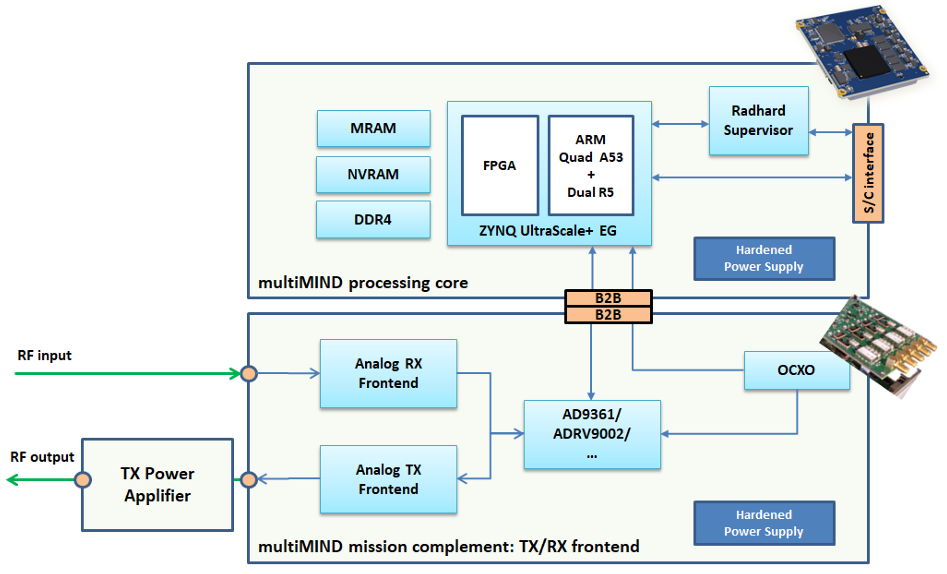
The multiMIND architecture is built around a clear separation of responsibilities: a high‑performance “COTS island” for computation and a fully radiation‑hardened “supervisor island” for safety, control, and recovery.
At the heart of the COTS island is the Xilinx Zynq UltraScale+ MPSoC (Multi‑Processor System‑on‑Chip). This device integrates four ARM Cortex‑A53 application processors, two ARM Cortex‑R5 real‑time processors, and a large FPGA (Field‑Programmable Gate Array) fabric with up to 341,000 logic cells. The MPSoC is paired with 4 GB of ECC‑protected DDR4 memory, dual 16 GB eMMC flash devices configured in pseudo‑SLC mode for robustness, and redundant NOR flash and MRAM (Magnetoresistive RAM) for configuration and bitstream storage. High‑speed JESD204B serial interfaces provide up to 100 Gbit/s of data movement between the processing core and mission‑specific RF or sensor frontends.
This COTS domain runs an adapted Linux environment—typically Yocto‑based or PetaLinux—allowing the reuse of existing drivers, protocol stacks, and FPGA IP cores. This dramatically reduces development time for mission‑specific applications such as software‑defined radio (SDR), image processing, or high‑speed data downlink.
The radiation‑hardened island is built around the Vorago VA41630 microcontroller, a hardened ARM Cortex‑M4 system‑on‑chip. This device manages all essential functions: power‑rail control, current and temperature monitoring, SEL detection, watchdog supervision, and telemetry/telecommand handling. It runs FreeRTOS and uses a modular “broker” architecture to route commands, generate housekeeping telemetry, and coordinate user‑defined tasks.
Crucially, the supervisor can shut down or reset the MPSoC within microseconds when a latch‑up is detected, preventing permanent damage. It also supports in‑orbit software and FPGA bitstream updates—even if the MPSoC is unresponsive—ensuring recoverability throughout the mission lifetime.
The hardware is packaged in a compact 9 × 9 cm cubesat form factor, with a heat spreader that doubles as a radiation shield. Mission‑specific RF frontends or companion accelerator boards (such as AI coprocessors) connect through FMC‑compatible high‑density connectors, enabling a “test‑as‑you‑fly” workflow from early prototyping to flight hardware.
Impact
The collaboration with Trenz Electronic was instrumental in turning multiMIND from a system concept into a manufacturable, flight‑ready product. Trenz contributed its long‑standing expertise in high‑density MPSoC module design, signal‑integrity‑optimized PCB layout, and reliable manufacturing of complex mixed‑signal systems. Their experience with Zynq‑based system‑on‑modules provided a mature foundation on which Thales Alenia Space could build the radiation‑mitigation architecture and mission‑specific software framework.
This partnership accelerated development in several ways. First, Trenz’s existing MPSoC platforms enabled early firmware and FPGA development long before the flight hardware was finalized. Second, their familiarity with high‑speed interfaces and compact mechanical integration ensured that the final design met cubesat constraints without compromising performance. Third, the collaboration reduced risk: Trenz’s proven industrial designs provided a stable baseline, allowing Thales Alenia Space to focus on radiation‑hardening strategies, supervisory logic, and system‑level reliability.
For Thales Alenia Space, the result is a competitive processing platform that sits between low‑cost COTS‑only solutions and expensive fully rad‑hard systems—offering high performance, robust operation, and reduced development effort. For Trenz Electronic, the project demonstrated that its MPSoC technology is suitable not only for terrestrial and industrial applications but also for demanding NewSpace missions.
Together, the companies created a flexible, modular, and radiation‑aware processing system that enables faster mission development, higher payload capability, and a scalable path toward constellation‑level deployments.
Contact:
Thales Alenia Space Deutschland GmbH
Thalesplatz 1,
D-71254 Ditzingen
https://www.thalesgroup.com/en/space
Trenz Electronic’s products are available worldwide through a network of authorized distributors. In North America, Trenz Embedded provides direct coordination and support. We look forward to hearing from you and exploring how we can support your design and development needs.
Trenz Embedded Inc
Mailing address:
218 Main Street, Suite 114
Kirkland, WA 98033
United States
Phone:
+1 (425) 532-6720
M-F, 9-5 Pacific
Thank you for your message!
We’ll get back to you asap.