
Automotive Rapid Prototyping System
Product
Modern Software-Defined Vehicle (SDV) architectures are pushing automotive in-vehicle networks towards more bandwidth and lower, guaranteed transport latency. These features are essential as cars are expected to be an integral part of a broader software and services eco-system, can be continuously updated/upgraded with new features, and achieve higher levels of autonomous driving.
The Central Car Server Project (CeCaS), funded by the German Federal Ministry of Research, Technology and Space (BMFTR) under the MANNHEIM initiative, was initiated to address these specific needs. The project is centered around developing central car server architectures and supercomputing platforms for next-generation vehicles.
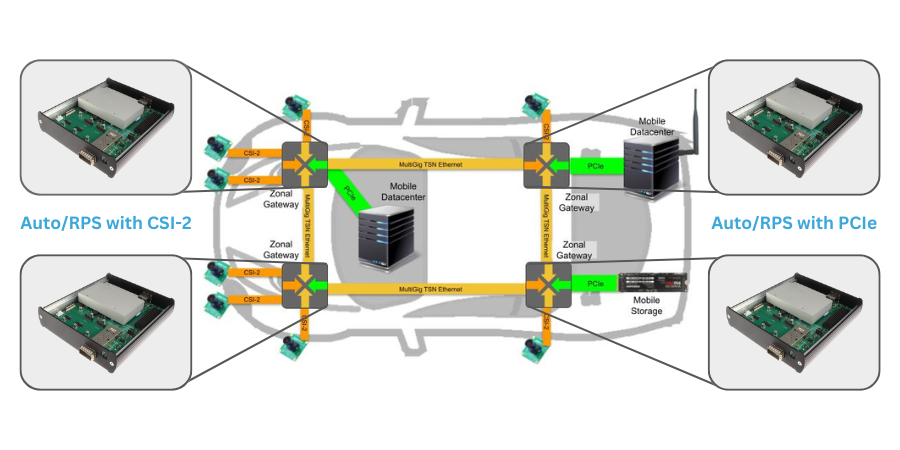
Driven by the needs of the CeCaS Project, Missing Link Electronics (MLE) and Trenz Electronic have partnered to put together the first commercial offering for a cost-optimized Automotive Rapid Prototyping System (Auto/RPS) for SDVs. This solution consists of a centralized computer, which connects with various Zone ECUs. The modular solution focuses on the specific requirements of software engineers: flexibility, scalability, and high re-use. Its data-centricity shifts software development from signal to data. It’s API-first approach helps to decouple and abstract vehicle specifics.
As a result, car manufacturers can quickly adapt the Auto/RPS platform to new technology, features, or models in a software-centric flow, and eliminating the need to modify the FPGA logic. These advantages directly address a need shared by the approximately 30 partner firms participating in the CeCaS project.
Implementation
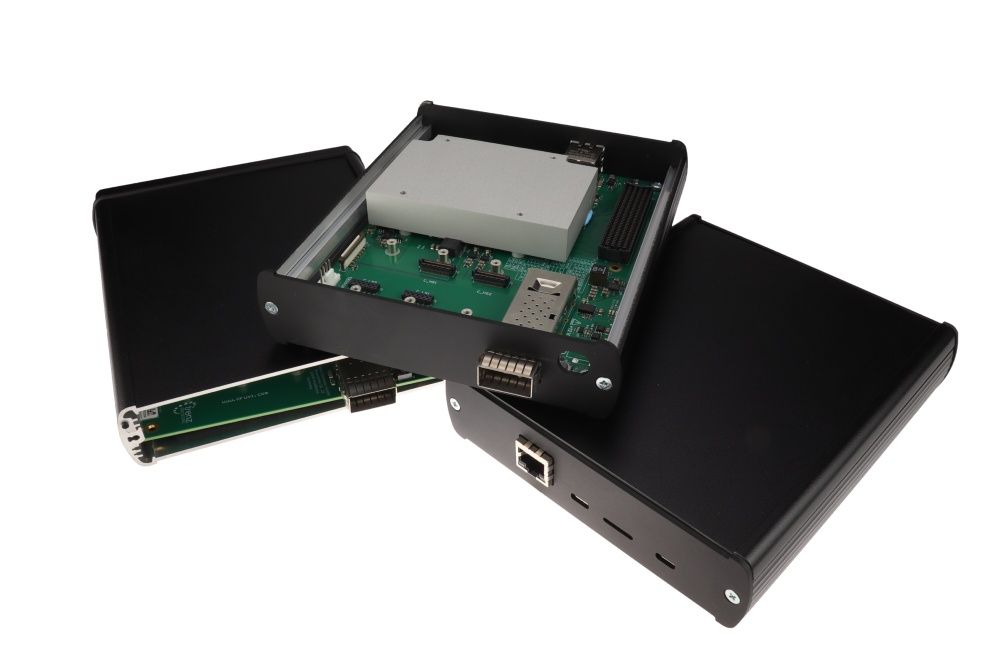
At the core of the hardware platform is a Trenz Electronic TE0950 evaluation board. This board features an AMD Versal AI Edge SoC, accompanied by generous RAM, storage, and configuration memory, along with gigabit ethernet, USB, and CRUVI interfaces, plus all the essential circuitry for simple single-voltage stand-alone use.
On top of this off-the-shelf hardware, MLE has implemented their comprehensive software stack, most importantly its Time-Sensitive Networking solution, Auto/TSN, over 25 Gig Ethernet, running on a pre-installed Debian Linux. MLE’s Auto/TSN in-vehicle networking technology offers deterministic networking at multi-Gigabit line rates. To achieve this, it combines modern open standards such as IEEE Time-Sensitive Networking (TSN), the Internet Protocol, reliable transport layer protocols such as the Transmission Control Protocol (TCP) or the Reliable Rapid Request-Response Protocol (RRRRP) together with protocol Full Accelerators.
The software stack makes optimal use of the compute module’s resources. Where needed, functionality is implemented in the module’s programmable logic fabric to achieve the desired performance. Where possible, functionality is running on the ARM processing system. The middleware is running on top of a Linux operating system. This approach best combines performance with maintainability, allowing the architecture to be adapted and expanded for years to come.
Impact
MLE follows a “proudly sourced elsewhere” philosophy, competing where necessary and collaborating when beneficial. This approach allows the firm to focus on their secret sauce: expert knowledge in domain-specific compute architectures.
MLE delivered the Auto/RPS platform from whiteboard to vehicle demo in just nine months. Such a breathtaking development pace would have been impossible following a “not invented here” approach. By integrating off-the-shelf hardware and software modules, MLE was able to not only significantly accelerate the development timeline, but also to maintain their lean team of only 20 certified FPGA developers.
Contact:
Missing Link Electronics, Inc.
2880 Zanker Road, Suite 203
San Jose, CA 95134, USA
https://www.missinglinkelectronics.com/
Trenz Electronic’s products are available worldwide through a network of authorized distributors. In North America, Trenz Embedded provides direct coordination and support. We look forward to hearing from you and exploring how we can support your design and development needs.
Trenz Embedded Inc
Mailing address:
218 Main Street, Suite 114
Kirkland, WA 98033
United States
Phone:
+1 (425) 532-6720
M-F, 9-5 Pacific
Thank you for your message!
We’ll get back to you asap.