
Compact Flow Cytometer
Services /
Compact Flow Cytometer
Product
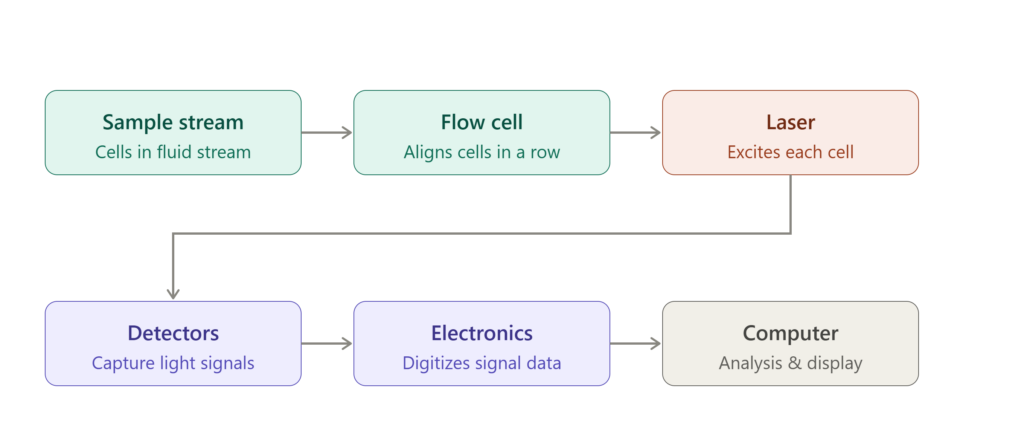
Flow cytometry makes the differences between individual cells measurable. Cells suspended in a fluid stream pass one by one through a focused laser beam. Each cell scatters the light in a characteristic way: forward scatter reflects its size, and side scatter reflects its internal complexity. Scatter alone can separate some cell types, such as the main white blood cell groups. For most research questions, however, cells are also tagged with fluorescent markers that bind to specific proteins. When the laser excites these markers, they emit light at different wavelengths. Optical filters split this light by color and direct it to photomultiplier tubes (PMTs), which convert even faint fluorescence into electrical signals. Thousands of cells per second can be analyzed, each described by multiple parameters at once. With the right markers, researchers can tell helper T cells from cytotoxic T cells and B cells or find a rare tumor cell population among healthy cells.
For a long time, flow cytometers were large instruments run by specialist operators. Compact benchtop systems now bring this technology to a much wider range of laboratories, while still delivering the sensitivity, speed and reproducibility of their larger predecessors.
Together with a client leading in biomedical equipment, Trenz Electronic co-developed such a compact, high-performance instrument. It serves demanding research environments in immunology, oncology, stem cell biology and clinical translational studies. The instrument automates sample handling, delivers precise multiparameter fluorescence measurements and supports reproducible cell analysis workflows. With ten optical channels, integrated sample preparation and intuitive software, the system enables researchers to quantify cell populations, monitor immune responses and characterize complex biological systems with high sensitivity and reliability.
Implementation
To meet the client’s requirements for precise, synchronized and low-noise signal acquisition, Trenz Electronic designed a distributed data acquisition architecture centered on a powerful Kintex 325 FPGA on the host board. Sixteen remote ADC modules interface with the photomultiplier tubes, each providing 10 MSPS at 16-bit resolution with exceptional low-noise performance. These modules connect to the host board over standard SATA cables, which carry data and synchronization signals through a custom protocol.
Time-synchronized ADC conversion ensures deterministic operation across all PMT channels, so the cytometer captures fluorescence events with high temporal accuracy. The host board integrates USB 3.0 and Gigabit Ethernet for high-speed communication with the main system controller. The complete instrument combines the host board, ADC modules, an industrial PC, a 15-inch touch screen and the liquid handling system in a single device designed for laboratory use.
Impact
Building such a flow cytometer requires precise optics and laser alignment, fluidics that reliably deliver single cells at a stable flow rate, carefully chosen detectors, and calibration procedures that make results comparable from run to run. It also demands knowledge of fluorescent markers and assay validation, analysis software that lets scientists interpret complex datasets, and the quality processes required to manufacture biomedical equipment. This know-how takes many years to build and is the secret sauce the client brought to the project.
High-speed mixed-signal design demands an equal amount of expertise, and this is what Trenz Electronic delivers. Sixteen photomultiplier channels must be digitized at 10 MSPS and 16-bit resolution, with low noise and tight synchronization, so that the faintest fluorescence signals remain measurable. Achieving this takes long experience in analog front ends, FPGA development and reliable electronics manufacturing.
When partners combine their respective strengths, the result is greater than the sum of its parts. In this joint development, Trenz Electronic was responsible for the electronics: the system architecture, the hardware design of the host board and ADC modules, and the FPGA development. The client contributed the rest of the instrument, including the optics, fluidics, application software, assay expertise and final instrument manufacturing.
For the client, the outcome is not only a flow cytometer with excellent performance. Even more importantly, the partnership accelerated development, reduced project risk, streamlined manufacturing of the electronics and created a forward-looking platform ready for future product generations.
Trenz Electronic’s products are available worldwide through a network of authorized distributors. In North America, Trenz Embedded provides direct coordination and support. We look forward to hearing from you and exploring how we can support your design and development needs.
Trenz Embedded Inc
Mailing address:
218 Main Street, Suite 114
Kirkland, WA 98033
United States
Phone:
+1 (425) 532-6720
M-F, 9-5 Pacific
Thank you for your message!
We’ll get back to you asap.