
Automotive Sensor Interface
Services /
Automotive Sensor Interface
Product
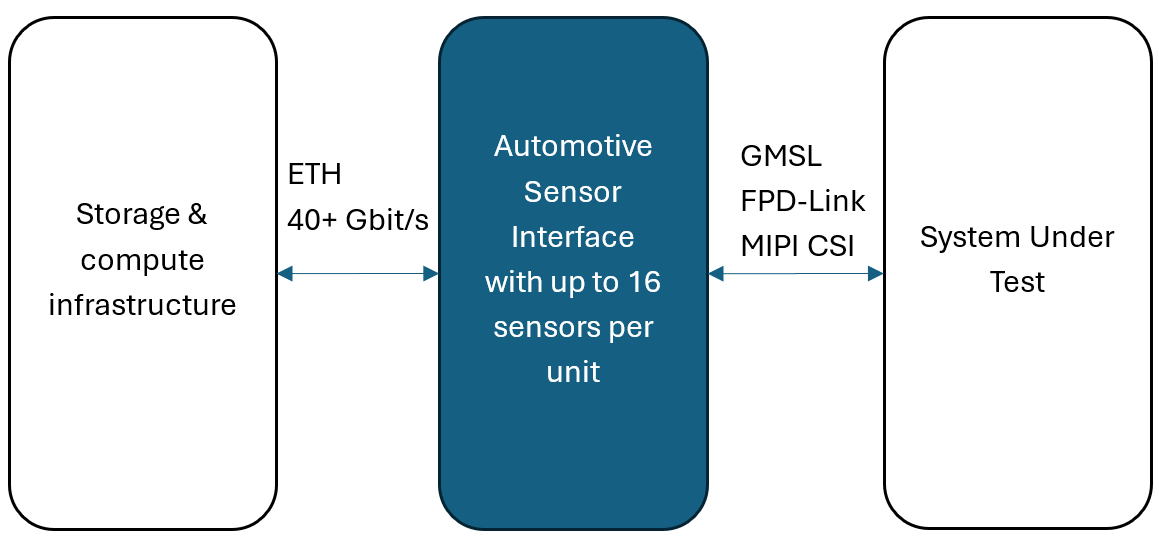
In Advanced Driver Assistance Systems and Autonomous Driving (ADAS/AD) development, engineers rely on precise and repeatable sensor stimulation to validate perception stacks, fusion algorithms, and domain controllers under realistic conditions. Automotive Sensor Interfaces deliver synchronized, high‑bandwidth raw sensor data such as camera, radar, and lidar directly into the target Electronic Control Unit (ECU). Using such sensor interfaces, teams replay real‑world recordings or generate synthetic sensor data in a Hardware in the Loop (HIL) setup. These interfaces provide a deterministic and hardware‑accurate injection path that supports confident testing of autonomous functions.
Together with a client leading in simulation and validation, Trenz Electronic developed an Automotive Sensor Interface that meets the demands of modern ADAS/AD ECUs. The product provides tightly synchronized data streams across GMSL2, FPD Link III and IV, and MIPI CSI 2 connectivity. High‑speed Ethernet paths enable 10G data replay and precise synchronization with the HIL system. The design excels at precise timing, low jitter, and real‑time adaptation of sensor data, enabling engineers to account for lens distortions, pixel noise, radar multipath effects, and lidar reflectivity variations. The product seamlessly scales to dozens of sensors while remaining flexible enough for rapid iteration.
Implementation
Trenz Electronic realized the project in close cooperation with the customer. Specifically, Trenz Electronic designed the hardware, while the customer provided their application expertise. The custom architecture centers on an AMD Zynq UltraScale+ MPSoC, which combines FPGA fabric, ARM processing cores, and high‑speed transceivers to create an ideal centerpiece for real‑time sensor data handling. The chip is accompanied by 8 GB of DDR4 memory, 128 MB of flash memory, multiple FMC connectors, a robust 24 V power design, and active cooling. Together, these elements form a flexible and expandable foundation capable of managing high‑bandwidth real‑time data and all system‑management tasks.
Within the FPGA, raw sensor data is preprocessed at aggregated rates up to 50 Gbit/s. The system supports pixel‑level manipulation, radar ADC injection, and lidar point‑cloud formatting. FMC modules provide future‑proof connectivity to the various sensor interfaces and ECUs.
Impact
The collaboration with Trenz Electronic has benefited the customer in multiple ways. By relying on Trenz‘s long‑standing expertise in high‑density MPSoC module design, signal‑integrity‑optimized PCB layout, and reliable manufacturing of complex mixed‑signal systems, the customer was able to focus on their core strength: deep domain knowledge in simulation and validation technology.
By basing the product on Trenz‘s mature MPSoC architecture, the customer significantly accelerated their development timeline and kept their design process lean and efficient.
The resulting sensor interface is a scalable, deterministic, and forward‑looking solution for ADAS/AD validation. It empowers engineering teams to test next‑generation autonomous functions with a level of realism and reliability that conventional approaches cannot match.
Trenz Electronic’s products are available worldwide through a network of authorized distributors. In North America, Trenz Embedded provides direct coordination and support. We look forward to hearing from you and exploring how we can support your design and development needs.
Trenz Embedded Inc
Mailing address:
218 Main Street, Suite 114
Kirkland, WA 98033
United States
Phone:
+1 (425) 532-6720
M-F, 9-5 Pacific
Thank you for your message!
We’ll get back to you asap.